SpectralUnmix
SpectralUnmix is an R package for smooth non-negative spectral unmixing of hyperspectral datasets and astronomical IFU cubes.
Model
The package solves
\[ X \approx A S\]
where X is a spaxel-by-wavelength matrix, A contains spatial abundances, and S contains component spectra.
Each input spectrum is modeled as a non-negative combination of a small number of latent spectral components. ## Output example
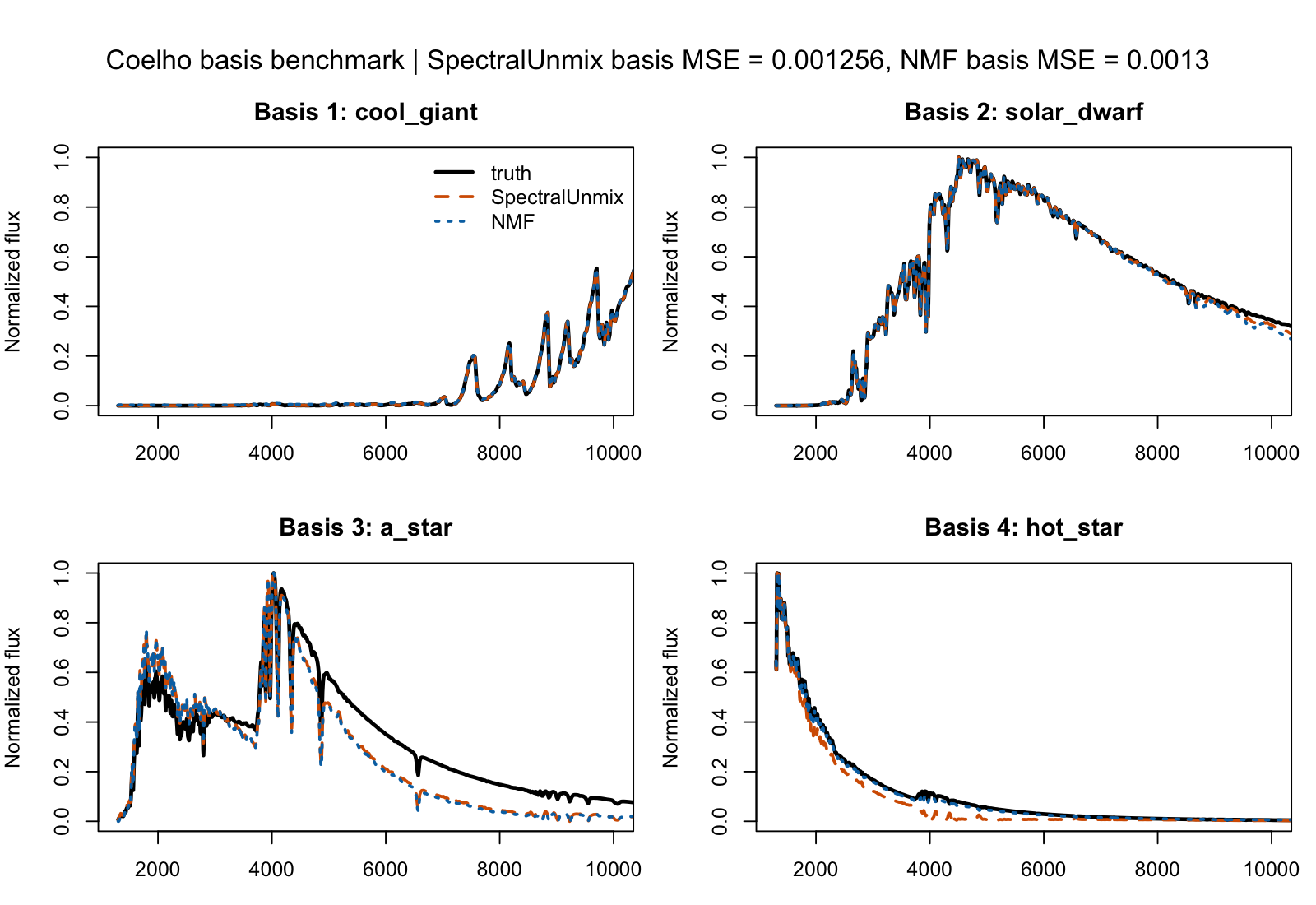
The figure below shows the Coelho-based benchmark used in the validation page. The comparison is made on a controlled mixture benchmark built from the bundled stellar spectra.
Reproducible example
library(SpectralUnmix)

demo <- coelho_demo_spectra()

fit <- spectral_unmix(
  demo$matrix,
  k = 4,
  lambda_smooth = 0,
  niter = 400,
  lr = 0.03
)

plot(fit, type = "spectra", wavelength = demo$wavelength)
plot_reconstruction(fit, demo$matrix, wavelength = demo$wavelength)
Main functions
spectral_unmix()fits the model.basis()andcoef()provide NMF-style accessors.fitted(),predict(), andresiduals()provide standard model methods.plot()andplot_reconstruction()provide quick diagnostics.cube_to_matrix()andmatrix_to_cube()remain available for IFU workflows.
Installation
# install.packages("remotes")
remotes::install_github("RafaelSdeSouza/SpectralUnmix")
torch must be available in the local R installation.